This post may contain affiliate links where we earn from qualifying purchases from referring you to our favorite products and brands. As an amazon associate, we earn from qualifying purchases. Find out more in our disclosure.
If you’ve ever stood at the bottom of a bunny slope repeating “make a pizza!” while your kid looks at you like you’ve lost your mind, you are not alone. Teaching young children to make a wedge shape on skis is genuinely hard, and most parents have no idea there’s a simple $12 tool that makes it dramatically easier.
In this episode of Skiing with Kids, I break down everything you need to know about the Edgie Wedgie — what it is, how it works, who should use it, and when to take it off. I’m a PSIA-certified ski instructor with over 20 years of experience, and a mom who taught all five of my own kids to ski before age three.
What Is an Edgie Wedgie?
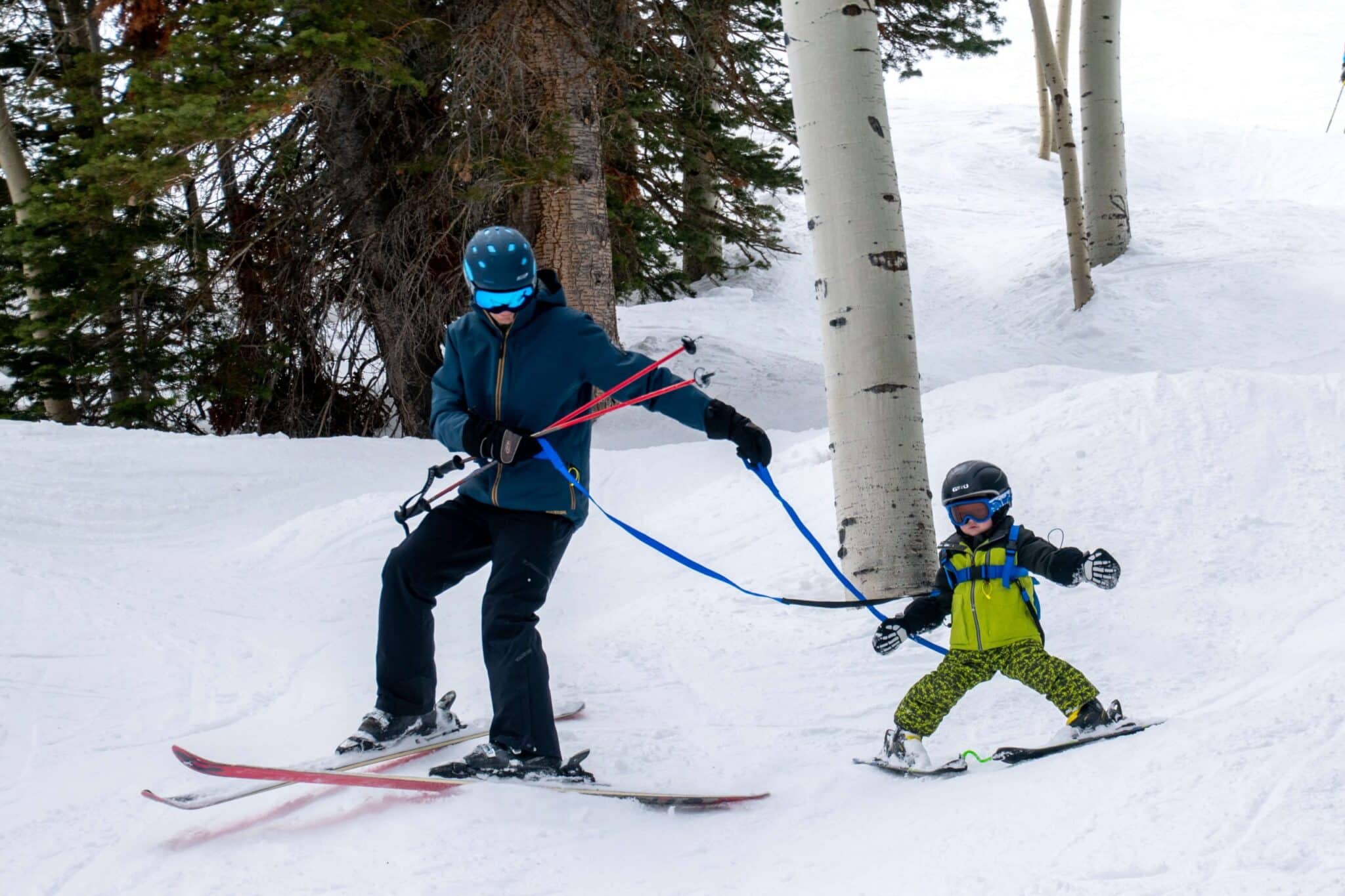
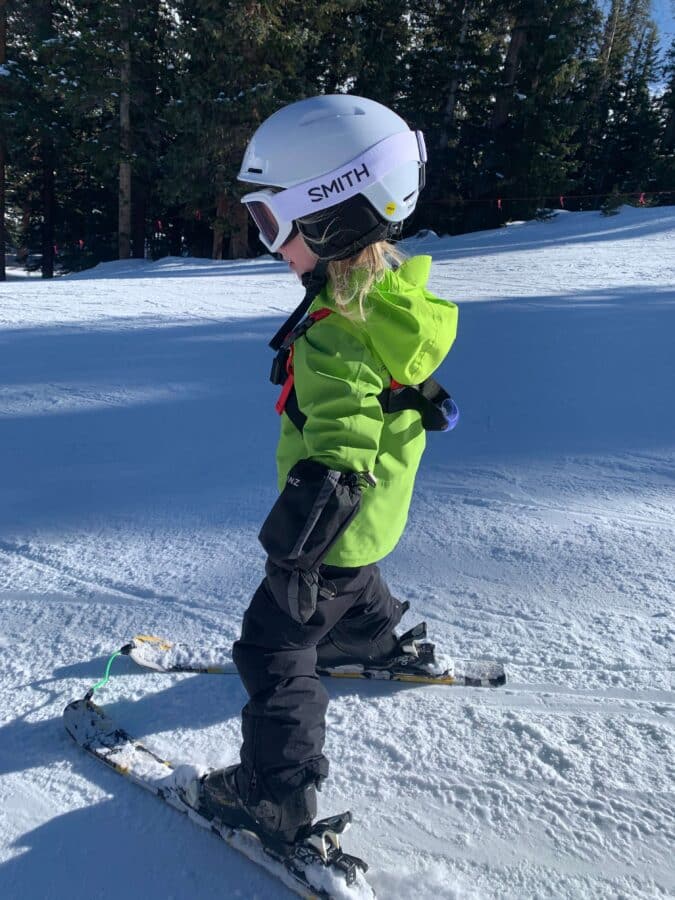
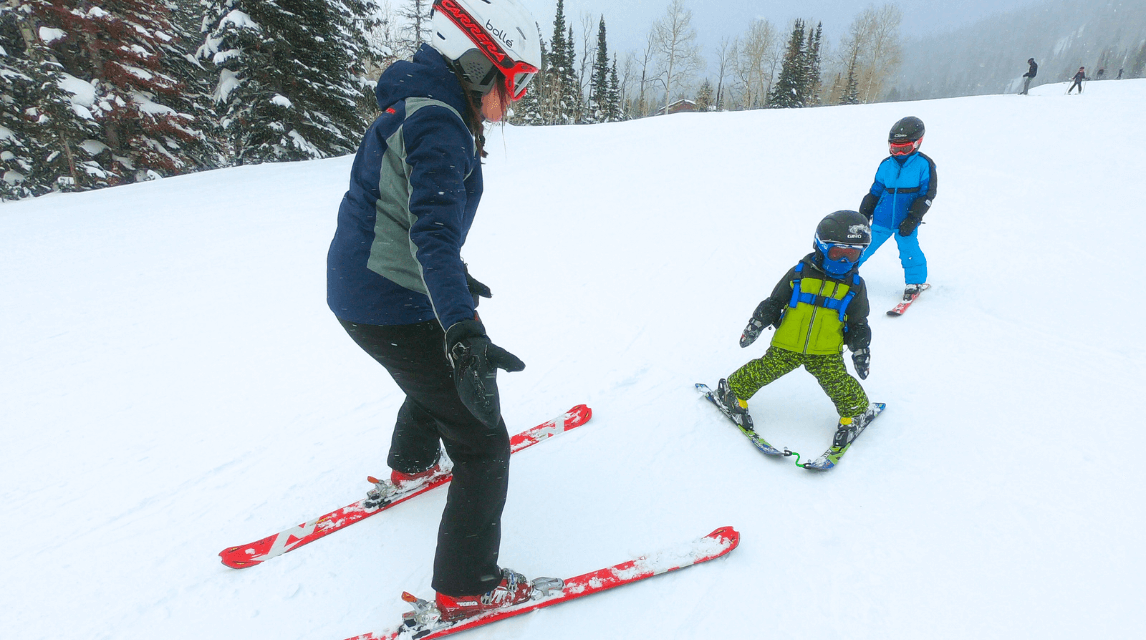
An Edgie Wedgie is a small bungee-like connector that clamps onto the tips of a child’s skis and holds them together. When the tips are connected, all a child has to do to slow down or stop is spread their legs apart. The Edgie Wedgie does the rest.
That might sound almost too simple. But “spread your legs” is something a young child already knows how to do. It’s already in their body. Compare that to “make a pizza shape” on slippery snow while also staying upright and managing speed, and you can see why so many kids struggle without this tool.
I compare it to training wheels on a bike. You use them to build confidence and muscle memory, and then you take them off once the child has found the movement on their own. The goal is always to get them skiing free.
What You Should Know About Edgie Wedgies
As a ski parent trying to figure out how to ski with kids, this episode covers the practical details most people never get in kids ski lessons or from a quick Google search:
- Why telling kids to “make a pizza” often backfires, and what to say instead
- Exactly who should use an Edgie Wedgie (kids six and under) and who shouldn’t
- The simple tension test that tells you when it’s time to take it off
- The one style of ski tip connector to avoid — and why it permanently damaged a pair of skis
- How children learning to ski progress faster when the tool matches where they actually are developmentally
The Downside of Edgie Wedgies for Skiing Kids
In the spirit of honest family skiing tips, I want to address the one real drawback: an Edgie Wedgie makes it harder for kids to shuffle across flat ground. Some parents skip it for that reason.
My take? I would rather carry my kid across a flat spot in thirty seconds than watch them spend an entire run without the ability to stop. One is a minor inconvenience. The other can set a child’s confidence back for a whole season.
Key Takeaway
“You’ve taken an abstract concept they couldn’t figure out and turned it into a physical action they already know how to do.”
The Bottom Line
If you’re skiing with kids under six, pick up an Edgie Wedgie before your next trip. They’re cheap, they’re easy to use, and they work. Say “spread your legs” instead of “make a pizza.” Watch for the slack. Take it off when their body is ready.
That’s the whole playbook for this tool, straight from a ski instructor who has used one for 22 years.
Resources and Links
- Listen to the full episode of Skiing with Kids with me wherever you get your podcasts
- Ready to teach your kids to ski with a real plan? Check out First Tracks: A Parent’s Guide to Teaching Kids to Ski at skiingkid.com
- What age should kids start skiing? — my full guide to figuring out the right time to start
- How to teach your own kids to ski — practical tips from someone who has done it five times over
- The best tools for teaching kids to ski — where the Edgie Wedgie fits into the bigger picture
Skiing with Kids Podcast Transcript
Welcome to Skiing with Kids. I’m your host Jessica, a ski instructor, mom of five, and someone who’s seen just about every ski day meltdown that you can imagine. After 20 years of teaching kids on the mountain, I’ve learned that great ski days aren’t about perfect technique. They’re about confidence, connection, and knowing what actually works. And this podcast is where we break it all down.
Today I want to talk about something that I have literally carried in my jacket pocket for the last 22 years. It costs about $12, fits in your hand, and it is hands down one of the most effective tools that I have ever used to teach little kids to ski. You guys, we are talking about the Edgie Wedgie today. And if you’ve never heard of it, or you’ve heard of it but weren’t sure if it was actually worth it or if it would help your kid, this episode is for you.
Now, the problem parents run into — and I see this every single weekend at the resort — is that a parent brings their kid to the bunny slope, gets their skis on, and then spends the next hour losing their mind repeating the same thing over and over again. Make a pizza. Pizza. Make the pizza shape. The kid tries. But here’s the thing, guys: the wedge shape is not a natural movement. Kids don’t walk around doing it in daily life. So they’re trying to make a shape their muscles have literally never made before, while standing on slippery snow, while being cold, and dealing with everything else that comes with being a little kid who’s new to the mountain.
What I see happen is this: your kid gets tense. They have their arms out at weird angles. Their knees are knocking together or bowing out. They start overthinking every single movement instead of just skiing. And the parent keeps explaining. And the more the parent talks, the more the kid gets confused. And by run three, somebody’s crying — and I’ll be honest, it’s usually the parent. I’ve been there. I have watched this happen hundreds of times. You guys, there is a better way.
So what is an Edgie Wedgie? Sometimes it’s called a ski tip connector. It’s a small bungee-like attachment that clamps onto the tips of a kid’s skis. They’re about six to eight inches long, usually in bright colors, with a little bit of stretch in the middle so it’s gentle on their legs. What it does is really simple: it holds their ski tips together. And that one thing literally changes everything for a beginner skier. Because when their ski tips are held together, all your kid has to do to make a wedge, to stop or control their speed, is spread their legs apart. That’s it. The Edgie Wedgie does the rest of the work.
“Spread your legs” is something a kid already knows how to do. Making a wedge is not. They’ve done it a thousand times. The moment you replace “make a pizza shape” with “spread your legs,” something clicks. Their body gets it immediately. Now, when I’m skiing with really tiny skiers, I’ll often tell them to make their skis really big. In their mind it clicks — they spread their arms wide and their legs follow. It is incredible to watch everything just fall into place for a kid when they make that wedge shape and stop for the first time.
I look at an Edgie Wedgie exactly like training wheels on a bike. You put training wheels on so your kid can learn how to pedal, control their speed, and build confidence before they have to manage everything on their own. And as soon as they figure that out, you take the training wheels off, because the goal is always to get them riding independently. Same thing with the Edgie Wedgie.
Edgie Wedgies are designed for young beginner skiers. I recommend them for kids six and under. Older kids and adults learning to ski should not use one. But for little kids, it is almost always the right call. In over 20 years of teaching kids to ski, I would estimate that fewer than 10% of the kids ages four and under that I taught were able to learn to stop without using an Edgie Wedgie. All five of my own kids started on one. Four of them started skiing around 18 months old — I know, I know, it’s a lot — but the Edgie Wedgie is what made that possible. Because at 18 months, you cannot explain a wedge to a kid. You can’t coach it. You just have to make it possible for their body to feel it and build that muscle memory. That is honestly the key to skiing with really little kids. They have dynamic bodies, they’re resilient, they can follow you down the hill — but if they can’t make that wedge, they can’t ski. So having an Edgie Wedgie for really little kids is a literal game changer.
Now, when it comes to how long to use one, I see parents making the biggest mistakes going both directions. Some take it off way too soon. Others leave it on way too long. The rule I go by is really simple: watch for tension. As long as your kid is actively pulling against the Edgie Wedgie and it’s getting tight when they move their skis, that means they still need it. Their body hasn’t figured out the movement on its own yet. Leave it on. The moment the Edgie Wedgie goes slack and loose more often than it’s tight — when it’s kind of just sitting there not really doing anything — that’s your green light to take it off. Their muscles have found the wedge independently.
For older beginners, maybe four, five, or six years old, that can happen within a single day on the snow. For really young ones — those two and three year olds, or if you’re starting them at one like we did — it might take a couple of seasons. My kids personally wore Edgie Wedgies until they were about three years old. That’s totally normal and there’s nothing wrong with it. The overall goal is to get it off as soon as your child can safely stop on their own. It’s a learning tool, not a permanent piece of gear.
Something I see consistently when parents skip the Edgie Wedgie and just try to verbally coach the wedge shape is that their kid is standing there trying so hard, completely stiff. Their legs are either super bowed out or collapsing in. Their arms are awkward and contorted at strange angles. The parent keeps demonstrating the pizza over and over, getting more animated and more frustrated internally. And the kid is trying as hard as they possibly can — they just can’t get it. All they need to do is relax, but mom and dad keep throwing more information at them. Put an Edgie Wedgie on that kid. I don’t even care if they’re seven or eight. Put it on for a run and tell them: all you have to do is spread your legs apart. Don’t say wedge. Don’t say pizza. Just: spread your legs. Watch what happens. The stiffness starts to melt away because they’re not thinking about the shape anymore — they’re just doing the movement. And the Edgie Wedgie turns that movement into a wedge automatically.
If you’ve already explained the wedge until you’re blue in the face, most kids just need a couple of runs to relax and feel what the wedge shape actually feels like in their body. You are taking an abstract concept they couldn’t figure out and turning it into a physical action they already know how to do. The Edgie Wedgie just takes the stress and pressure off.
Now, if Edgie Wedgies are so great, why don’t ski schools use them? Honestly, that’s a really good question, and I have talked to every single ski school manager I’ve worked under about exactly that. Here’s the truth: most ski schools are designed to cater to kids ages five and up, even if they occasionally take younger kids. A majority of kids over five can figure out a wedge on their own, so ski schools often look down on Edgie Wedgie use — not because it’s ineffective, but because it’s not really designed for their target student. I’ll be honest: most ski schools take their lessons designed for elementary school age kids and just simplify them a little for younger ones. For the last couple of years I almost exclusively taught three and four year olds, and I’ll tell you — every single instructor I worked with carried a stash of Edgie Wedgies in their pocket. Our ski school didn’t like them and refused to provide them, but they were perfect for the kids we were teaching. None of us would go on the mountain without them.
There is one real downside to using an Edgie Wedgie, and it’s worth knowing going in. When a kid’s ski tips are connected, it’s really hard for them to shuffle their skis and move across flat ground — like on a cat track or at the base of the mountain. Some parents choose not to use one for that reason. I get it, sort of. But I would rather help my kid scoot across a flat spot for thirty seconds than have them struggle through an entire run without any ability to control their speed or stop. Not being able to shuffle is a minor inconvenience. Struggling without a wedge can set a kid back a whole season, develop bad habits, and honestly feels like a legitimate safety concern. For most families skiing with young kids, the trade-off is an easy one to make.
Before you buy, you also need to know that not all ski tip connectors are the same. The original Edgie Wedgie uses two C-type clamps — one on each ski tip — that twist down and lock tight. That design has been around for decades, it works, it stays put, and it won’t cause real damage to your skis. In recent years, tooth-clamp versions have started showing up that just close down without tightening. Don’t get those. We tried several of them and discovered the teeth on the bottom were grinding into the base of the skis every time they moved. The damage was irreparable. They also don’t stay put as well, so they keep twisting and grinding on your bases. Stick with the original. They’re $10 to $15, they last forever, and they do exactly what they’re supposed to do. I’ve had one in my jacket pocket for 22 years. If it breaks, I just cut it a little shorter and slide it back onto the clamp.
If you’re headed to the mountain with kids six and under — especially beginners, or if last season was a struggle and they never got that wedge solid — pick up an Edgie Wedgie before you go. You can order one on Amazon or find them at most ski shops at the base of the mountain, though occasionally they sell out. We’re past the teaching-kids-to-ski phase in our family, but I still always carry one. So many times I’ve loaned it out to families on the mountain who are struggling. Have it ready, but don’t put it on your kid until you see they actually need it. There will be that occasional kid — that 10% — who figures out the wedge right away without one.
Once you realize they need it, all you need to do is say “spread your legs” instead of “make a pizza.” Watch for the slack. Take it off when their body is ready. That’s it. That’s the whole playbook for this tool.
And if this is clicking for you — if you’re realizing there’s a whole layer to skiing with kids that nobody really lays out clearly — that’s exactly what my course First Tracks: A Parent’s Guide to Teaching Kids to Ski is built for. It’s designed specifically for parents, walking you through how to actually teach your kids to ski in a way that works and makes them want to come back, from someone who has taught hundreds and hundreds of kids. You can find it at skiingkid.com — just click on the First Tracks tab. Thank you so much for listening today, and I can’t wait to see you out on the mountain.