

This post may contain affiliate links where we earn from qualifying purchases from referring you to our favorite products and brands. As an amazon associate, we earn from qualifying purchases. Find out more in our disclosure.
You just spent a small fortune on kids ski lessons. Lift tickets, rentals, the lesson itself — you did the math and then immediately decided not to think about it anymore. Your kid came back with rosy cheeks and a vague story about a game they played. You said “sounds fun!” and headed to the car.
And just like that, you left the most valuable part of the day behind.
As a PSIA-certified ski instructor with 20 years of experience and a mom who has taught five kids to ski, I’ve watched this happen at pickup more times than I can count. Parents invest so much in ski school and then walk away without asking a single question. Not because they don’t care — but because nobody told them there was gold waiting if they just asked for it.
Here’s what most parents don’t realize: your child’s ski instructor just spent four hours figuring out your kid. What makes them laugh. What shuts them down. What words actually work. What terrain built confidence and what terrain produced that face — you know the one. All of that insight exists, and it’s yours for the asking.
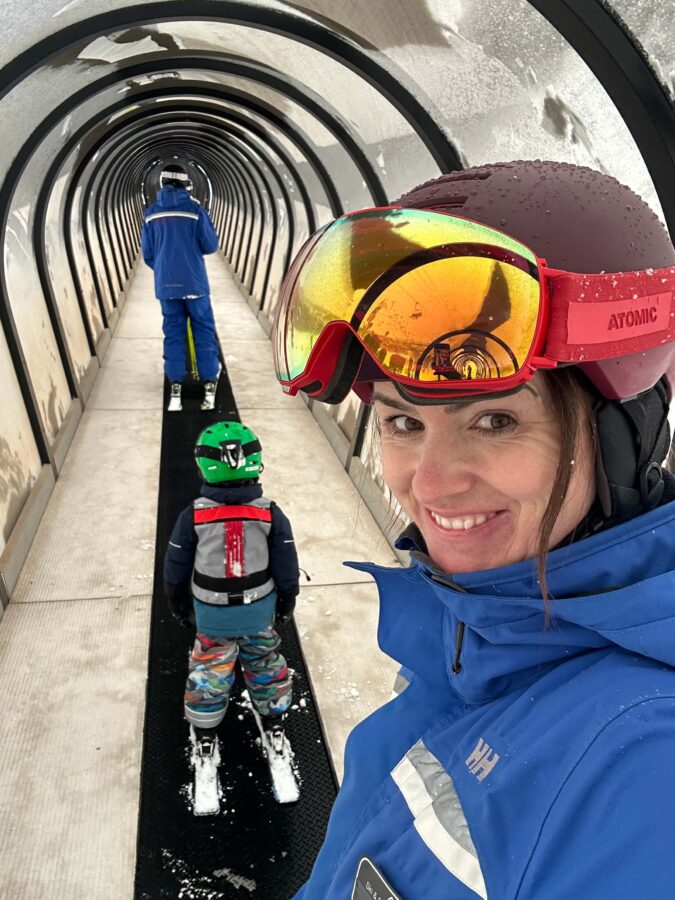
The 7 Questions Worth Asking Your Childs Ski Instructor
Before you head to the parking lot, find a quiet moment with the instructor and ask these:
- What did my child do really well today?
- Where do they need more work, and how can I help as a parent?
- What specific words or phrases were you using to teach them?
- What runs did you ski, and where would you recommend taking them next?
- What does my child need to practice to get to the next level?
- What did my child respond best to today?
- What games did you play, and how do they work?
That’s it. Five minutes, seven questions, and you walk away knowing more about your child on the mountain than most ski parents ever find out.
Why This Changes Everything About Ski School
One of the most underrated family skiing tips I give parents is this: use the same language as the instructor. Kids’ ski instructors are brilliant at finding the exact phrase that makes a skill click. “Stomp on that bug.” “Hold your hands out like a pizza tray.” “French fry to go fast, pizza to slow down.” Once a kid has that phrase in their head, it works every time.
But when you show up the next weekend with your own version of the same instruction, it lands like a foreign language. Your kid stares at you. You repeat yourself. Nobody has fun. That’s not a parenting failure — you just didn’t have the password. Ask for the passwords.
The question about games is equally important. The best approach to children learning to ski isn’t drills — it’s games that sneak the skill in through the back door. Red Light Green Light is a stopping drill. Follow the Leader builds technique through mimicry. When you know what games your child played, you can keep playing them on your family ski days. Your kid thinks you’re just having fun. You know exactly what you’re building.
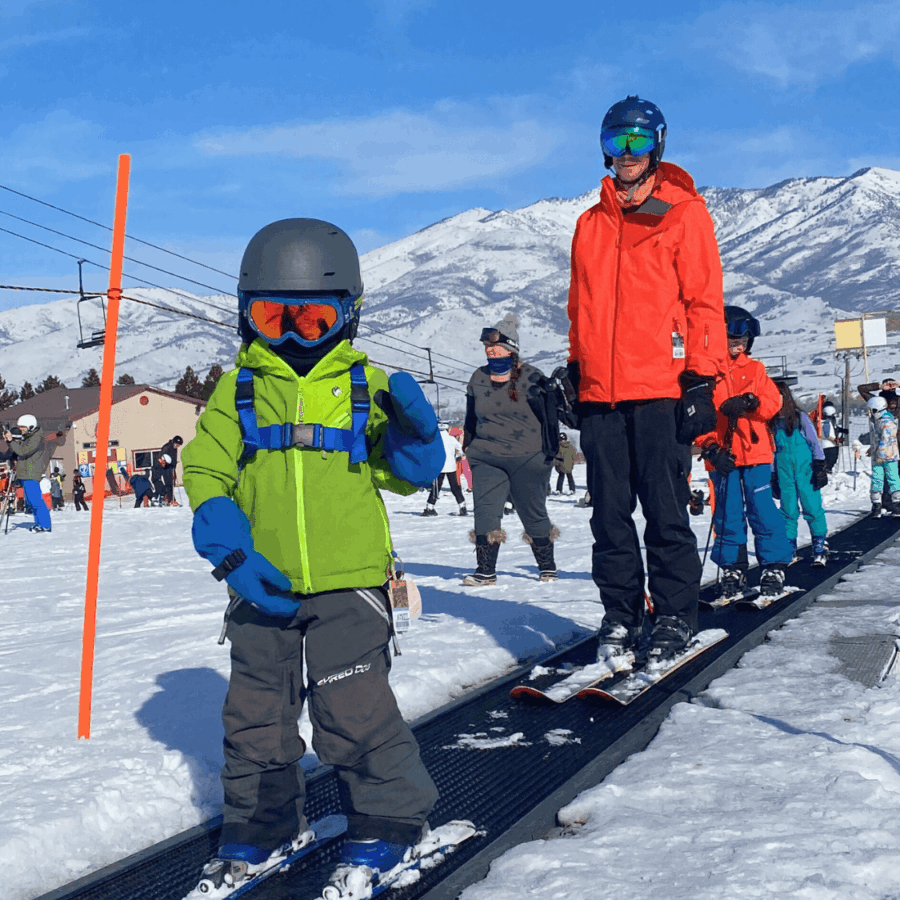
The Bonus Move After Ski School
After you’ve talked to the instructor, go take two runs with your kid. I’m serious. The skills they learned today are at peak freshness right now. If you wait until next weekend, some of it fades. Two runs today locks it in for free.
Tell your child before drop-off that morning that you’ll be skiing together after school and you cannot wait to see everything they learned. They’ll spend the whole lesson thinking about what to show you. When you ski together, let them be the expert. Ask them to teach you the games. Be genuinely impressed, even if the pizza wedge is a little wobbly — because they worked on it all day and they want you to see it.
That’s how to ski with kids in a way that actually builds something.
Key Takeaway
“You’re not just picking up your kid. You’re picking up four hours of professional insight about your child on the mountain. Don’t leave it behind.”

Resources and Links
If you want to go deeper on making the most of ski school, these are worth a read:
- Getting the Most Out of Ski School for Kids
- Teaching Kids to Turn on Skis: Tips, Games, and Techniques
And if you’re ready to stop piecing things together and start skiing with a real plan, check out First Tracks: A Parent’s Guide to Teaching Kids to Ski at skiingkid.com. It’s built specifically for ski parents who want to give their kids the best possible start on the mountain.
Skiing with Kids Podcast Transcript
All right, parents. I want to have some real talk here on the podcast. Today we are talking all about ski school and the ways that you can get the most bang for your buck.
So let’s just imagine you just signed your kids up for ski school. You spent what feels like a small fortune — we’re talking lift tickets, the rental gear, the lesson itself, all the outerwear, the clothing, all the things. You started doing the math at breakfast and then you quickly decided you probably should just not think about it anymore. You finally got there, you’re juggling all the things, and your kid disappears with this stranger in a helmet for six hours. Maybe you had an awesome day out skiing by yourself, or maybe you decided to try and relax but stood around drinking overpriced hot chocolate trying not to think about whether your child was somewhere out on the mountain crying or actually having a good time. Both are valid.
And then you walk to pickup at the end of the day, your kid runs over, and you say — and I know you said this, because literally every parent that has picked a child up from ski school when I’m teaching says this — “So, did you have fun today?” And maybe you get a shrug. Maybe a “yeah, it was fine.” Or if you’re really lucky, they start babbling about some game they played or this trail through the trees that you don’t even know what they’re talking about. And that’s really about it. You grab your kid, thank the instructor, head to the car, and call it a successful ski day.
But here’s the thing that’s missing. You just left so much on the table and you had no idea.
That instructor your kid was skiing with hopefully spent the last six hours cracking the code on skiing with your kid. They figured out what makes them tick on the mountain, and they probably saw what shuts them down too. They know what words actually work, what runs built their confidence and which ones tore it down, and which games made them totally light up. They built a lot of rapport and learning with your kid. And unless you ask for it, it just goes away.
Today I’m going to give you seven questions you should be asking your child’s ski instructor every single time. These are the questions that turn a one-day lesson into something that actually carries forward — into more learning, into your family ski days, into the next season. This is what helps ski school build the scaffolding for a kid who genuinely loves being on the mountain. As both a ski instructor and a mom of five, I’ve been on both sides of that pickup conversation more times than I can even count. Hundreds of times. So I want to help you get the most for all those ski school dollars so you can help your kid in the best way possible. Let’s do this.
Before we get to the questions, I just want to talk about one thing really quick. If you have not put your kid in ski school before, you might not be totally prepared for the absolute chaos. And I don’t mean just a little bit of chaos — it is full blown chaos when you pick your kid up from ski school. You got a little taste of that at drop off, but the afternoon is just wild. I need you to know this so you don’t walk up, see that instructor who looks slightly unhinged, and decide this probably isn’t a good time.
Every parent shows up at the same time. They all want to talk to the instructor, they all want to talk to their kids, and every kid is either totally wired from the day or completely exhausted. The ski instructor has been outside in their ski boots for probably seven hours. They have a gaggle of kids literally hanging off their arms, and to be honest, they probably have to pee. It is a lot. So here’s what I want you to do: walk up, grab your kid, and say to the instructor, “Hey, I’ve got a few questions — I’m happy to wait over here to the side until things settle down a bit.” That’s it. Just let them know you’re not in a rush and that you actually want to talk, and then be patient. They’re going to have a lot of parents wanting their attention, and most of those parents are just going to get a quick checklist and be off. You probably won’t be waiting very long.
I also want you to know that most ski instructors will be genuinely thrilled that you want to talk to them. Engaged parents who have real questions beyond “how was your day?” are not the norm at pickup. You showing up with actual questions is going to make their day. Or at least the last ten minutes of it.
Okay. Questions. Let’s get into it.
Question one: What did my child do really well today?
Always start here. Not because we’re doing a participation trophy sort of thing, but because it gets you real, useful information. You’re going to find out what came naturally — not necessarily what they worked on, not what the instructor pushed them toward, but what actually clicked. Maybe it was balance. Maybe they’re fearless in the trees. Maybe your kid has zero technical skill but an absolutely unhinged willingness to try anything. Those things are all worth knowing.
And here’s the thing about praise, because your kid is going to hear this: generic praise is basically useless. “Oh, you did so good today!” Cool. Your kid stores that under “good job, you’re the best” and for most kids it doesn’t mean very much by tomorrow. But specific praise lands totally differently. “Hey, your instructor said your balance is actually really impressive for your age” — your kid is going to think about that on the chairlift for the rest of the day, and possibly for the rest of the season.
There’s also a sneaky second reason to start here: you are setting the emotional tone for the rest of your day. Your kid has had a really big day with a lot of feelings, and the story they’re walking away with from ski school really matters. You want to prime the pump so that what they’re thinking when they leave is “I’m good at this” — not “I’m still learning and it’s kind of hard.” Both might be totally true, but only one of them makes them want to come back next week.
Question two: Where do they need more work, and how can I as a parent help?
Notice that second part. “How can I help as a parent?” That’s the most important bit that most people forget to add. Because you are not a ski instructor, and even when you’re teaching your kids something, you’re doing it differently than they do in a group class setting. But you can absolutely be a useful practice partner if you actually know what to work on. There’s a big difference between randomly telling your kid their form is wrong and knowing they’re working on linking turns and casually suggesting you count turns together on the next run. One of those feels like tearing them down. The other one feels like you’re just skiing together. Same run, totally different vibe. So get the information, but hold it lightly. Your job is to know what’s helpful, not to be a strict enforcer.
Now, if you’ve taken my course First Tracks: A Parent’s Guide to Teaching Kids to Ski, you have a huge advantage here. Before you drop your kid off, get a good idea of the drills that are at their level from the course, and talk to the instructor about which ones they think would be most effective with your child. First Tracks isn’t designed so that you always do everything on your own — ski school can be a really useful part of the process, especially when you’re working on something difficult or your kid just isn’t getting something. Ski school and First Tracks work really well together.
Question three: What specific words or phrases were you using to teach them?
This is my absolute favorite question, and I think I’ve only been asked it as a ski instructor maybe once, which is wild to me because it is so useful. Kids’ ski instructors are genuinely incredible at finding the exact right words to make something click. They’re not going to say “transfer your weight to your downhill ski while keeping your hips facing the fall line.” They’re going to say “stomp on that bug in your boots” or “push your knee toward your pinky toe” or “hold your hands out gently like you’re carrying a pizza — don’t drop it.” And once a kid hears that phrase, that thing they already associate with a skill, it works like a magic word. Every time.
The problem is when you don’t ask and you show up the next weekend and try to give them your own helpful cues. You say something perfectly logical and your kid stares at you like you’re speaking a foreign language. You say it again louder, you say it faster, and now everyone’s frustrated and you’re not even past the magic carpet. It’s not your fault. You just didn’t know the language they were taught. So ask for those code words. Pull out your phone and write them down right there at pickup — do it on the spot, because you will forget by the time you get to the parking lot. These phrases are worth gold, and they cost you absolutely nothing to ask for.
Question four: What runs did you ski today, and where would you recommend taking us next?
Here is a trap that catches parents every single time. You look at the trail map, you see green runs, and you think “green means easy, we’ll be fine.” And then you take your newly ski-schooled six-year-old onto a green run that happens to be narrow and steep and icy and basically a luge track with trees, and you spend the next twenty minutes doing a very stressful sidestep descent while your kid freaks out.
Not all greens are equal. Not all blues are equal. I cannot stress this enough. I have seen runs labeled green that would genuinely humble intermediate adult skiers. Think of trail maps as a suggestion, not a promise. Your child’s ski instructor, on the other hand, has skied this mountain over and over again — not just with your kid today, but with so many kids throughout the season. They know which runs are going to build confidence and which ones are going to produce that face. You know the face. The eyes go wide, the body freezes, and suddenly your child has very strong opinions about going inside for hot chocolate. Ask them specifically: what runs worked? Where should we go? What should we avoid right now? This is free expert advice from someone who spent the whole day with your kid and knows the mountain inside and out. Use it.
Question five: What does my child need to practice to get to the next level?
There’s a big difference between just skiing and actually getting better at skiing. And for kids, the difference is almost entirely about whether practice feels like a game or it feels like a job. If you put your kid on a run and say “okay, I want you to focus on your turns,” you’re going to get one half-hearted attempt and then they’re going to go back to pointing downhill and hoping for the best. But if you say “I bet you can’t make it all the way down using only tiny turns” — now you have their attention. Now there’s a challenge. Now they’re doing the exact same thing but they think it’s a competition, and they’ll do it twelve times before you can suggest moving on. That’s just how their brains work.
So ask the instructor what skill to focus on, and then ask what games they used to teach it. They will have so many ideas because this is literally what they do all day. Come home with a specific challenge, not a vague “work on your turns” instruction that’s going to evaporate in the parking lot.
Question six: What did my child respond best to today?
This one is about cracking the code on how your specific kid learns — which, if you’ve been trying to figure it out for years without much success, might be worth asking someone who just spent six dialed-in hours with your kid. Some kids need competition. Everything is a race, everything is a challenge, and the second you make something feel high stakes they are completely locked in. Other kids completely shut down the moment they feel any pressure and need everything framed as low-key and no big deal. Some kids need you to explain the why before they’ll even try something. Some need you to show them and then just get out of their way.
Before you say “I already know how my kid learns” — you probably know some of it, but a ski instructor who sees hundreds of kids a season is really good at reading what works, because figuring it out makes their job easier. When the instructor tells you “she completely transformed the second I made anything a race” — you now have a tool you can use every single ski day for the next decade. That’s not nothing.
Question seven: What games did you play today, and how do they work?
This is the one. If you only remember one question from this whole episode, make it this one. The best ski instructors teach almost entirely through games — not because kids can’t learn real skills, but because when a kid is focused on a game, they’re focused on winning, and the skill sneaks in through the back door. They’re so pumped about playing Red Light Green Light that they don’t even realize they just learned to stop, start, and use their edges. Follow the Leader is teaching them to make smooth turns and be fluid in their movement, but they’re not even thinking about it. The skiing just becomes natural because it becomes second nature through play.
When you walk away with the games, you walk away with a toolkit for every family ski day for the rest of the season. You don’t have to come up with every drill. You don’t have to be the perfect coach. You just suggest a game your kid already played that day, and they immediately want to do it because they already like it — and because they want to show you how good they are at it. Kids love having that inside edge where they know something mom or dad doesn’t. Let them be the expert. It is so much easier than trying to give technical feedback. Ask for the games.
If you’re in my course First Tracks: A Parent’s Guide to Teaching Kids to Ski, you’ve already learned a lot about games on skis and why this is usually the best way to teach kids. If you haven’t joined First Tracks yet, you can find it at skiingkid.com under the First Tracks tab.
The bonus move: ski with your kid after the lesson.
I said seven questions and those are the seven. But I really cannot let you go without saying this: after you talk to the instructor, go ski with your kid. Even if it’s just a couple of runs. Please. I am begging you. I know you’re tired. I know your kid’s probably tired. I know it’s getting late and there is a very compelling argument for hot chocolate. But the stuff your kid learned today is at peak freshness right now. Their muscles remember it. Their brain remembers it. Everything the instructor carefully built is sitting right there, totally accessible. If you wait until next weekend, some of it fades. Not all of it, but enough that you’ll spend half the morning warming back up to where they were yesterday. You paid for a six-hour lesson and you could basically extend it for free by just taking two runs together.
Here’s the move I love: before drop-off in the morning, tell your kid that after ski school you two are going to take some runs together and you cannot wait to see everything they learned. That does three things. One, they have something exciting to look forward to all day. Two, they’re mentally preparing to show you things, which means they’re paying more attention in the lesson. Three, when you actually ski together, they’re the expert and you’re the student — and there is nothing a kid loves more than that. Have them show you the games. Ask them to teach you the phrases. Let them explain what they’re working on. When your kid is actually teaching you something, they are cementing what they’ve learned in their own brain. You are not just extending the lesson. You are turning the whole day into a shared experience — and that’s the stuff they remember. That’s what makes them want to come back.
So if these questions are so helpful, why doesn’t everyone ask them? Honestly, because nobody told them to. The resort doesn’t hand you a sheet that says “here are the questions you should ask at pickup.” Most ski schools just give you a generic skills checklist that tells you your kid worked on pizza and stopping — which, great, thanks, most of you could have guessed that. Some of it is the chaos of pickup. Everyone’s cold and hungry and a little over it. And some of it is that parents assume the lesson summary checklist is the whole picture. It is definitely not. As a ski instructor, I can tell you there is so much more that goes into a lesson than that checklist. That’s the official version. The real version — what actually clicked, what the instructor figured out about your kid, the language that worked, the games that landed — that’s only available if you ask. This takes three to five minutes at pickup. That’s it. And the parents who asked these questions when I was teaching were always the ones whose kids improved the fastest. Not because their kids were more talented — because the parents knew how to actually help. That’s a skill. And it starts with asking.
Here’s what I need you to walk away with today. After your kid’s next ski lesson, find a quiet moment with the instructor and ask these seven questions: What did they do really well today? Where do they need work and how can I help as a parent? What specific words and phrases were you using? What runs did you ski and where would you recommend taking them next? What do they need to practice to get to the next level? What did my child respond best to? And what games did you play today and how do they work?
Put them in your phone right now. I’ve also listed them all in the show notes so you’ve got them right there when you need them.
And then go take two runs with your kid. Let them show off. Let them be the expert. Your only job is to be genuinely impressed — even if the pizza wedge is a little wonky, because they worked on it all day and they want you to see it. Be curious about your kid on the mountain. Be fully engaged in the process. Ask questions. Ski with them. The technical stuff will come. What you’re really building is a kid who feels like you’re in it with them — and that is what makes this sport something they want to do for the rest of their life.
If you found this episode useful, please send it to another ski parent who’s doing ski school this season. I’ll see you out on the mountain.