

This post may contain affiliate links where we earn from qualifying purchases from referring you to our favorite products and brands. As an amazon associate, we earn from qualifying purchases. Find out more in our disclosure.
Most parents assume kids decide whether they love skiing somewhere on the mountain — maybe after a great run, or once they’ve finally figured out how to stop. But I’ve been teaching kids to ski for over 20 years, and I can tell you the real decision happens way earlier than that. And it happens in about two seconds.
Here’s what that moment looks like, why most parents miss it, and what you can do differently starting on your very next trip.
What’s Happening
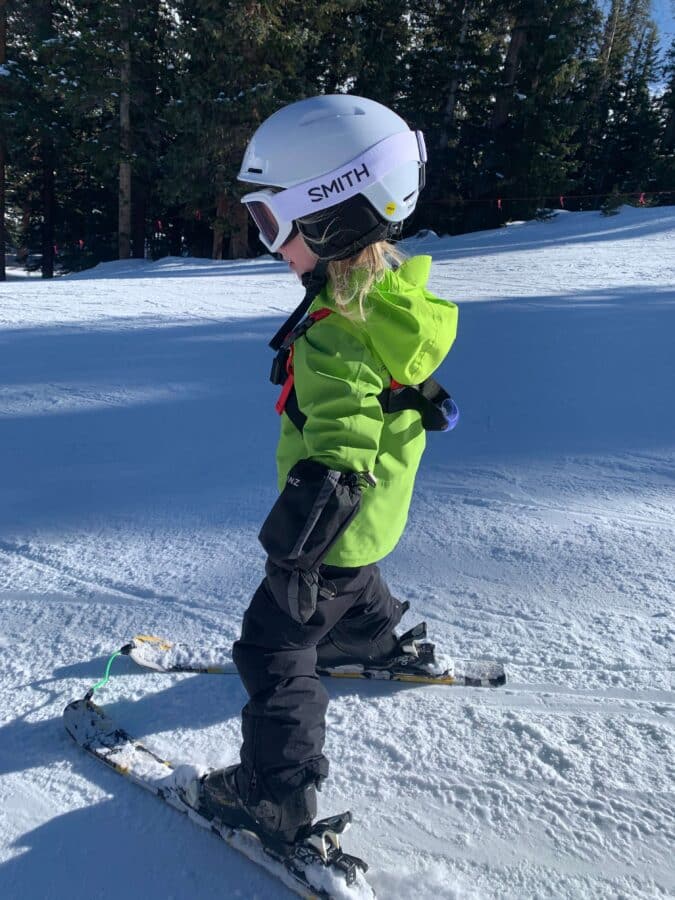
It’s not when they fall. It’s not when they’re cold or struggling or complaining their boots hurt. The moment children learning to ski make up their minds happens the first time they feel overwhelmed and look up at you.
That look is a question. “Am I safe here? Am I capable here?”
What they see on your face in that split second becomes the story they attach to skiing. Panic teaches them skiing is scary. Frustration teaches them it’s pressure. Calm confidence teaches them something completely different: this is hard, and I can do hard things.
Here’s the thing I come back to over and over again when I’m working with families: kids don’t quit activities because they’re hard. They quit because they feel out of control.
That’s the difference between a kid who falls and pops right back up, and one who falls and decides they’re done for the day.
The Moments That Make or Break Ski Days
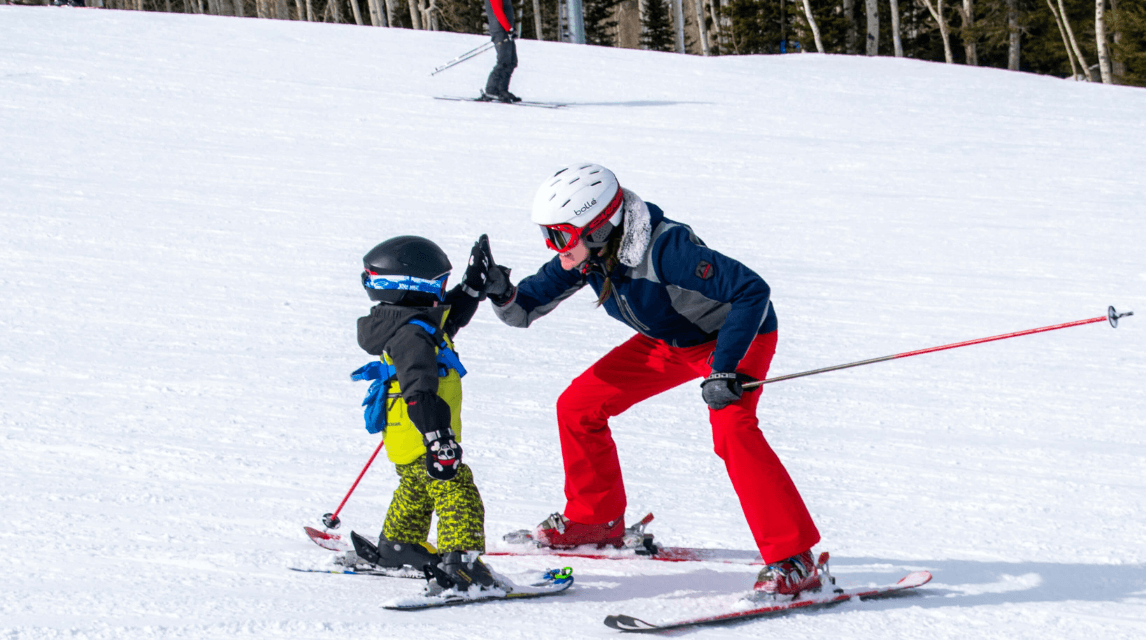
In my experience as a ski instructor and as a mom who taught all five of my own kids to ski, there are three moments where kids are especially tuned in to everything around them.
The first is getting the boots on. Before anyone touches snow, the experience is already being shaped. Ski boots are stiff and uncomfortable and nothing like anything kids have worn before. Slowing that moment down, making it feel purposeful instead of rushed, goes a long way. I tell my kids the boots feel stiff on purpose because they’re built to control the mountain. That reframe helps.
The second is the first fall. One of my favorite family skiing tips is what I call “pre-loading the fall” — you actually practice falling and getting back up in a flat spot before you ever get near a slope. When kids have rehearsed it, a real fall lands completely differently. Instead of panic, you get something closer to pride.
The third is the first taste of real movement. That two-second window where it stops feeling like controlled falling and starts feeling like flying. When you see it on their face, don’t move on. Name it out loud. “Did you feel that? That was YOU controlling the ski.” Anchor it. Give them something to come back for.
What Ski Parents Get Wrong
The mistakes I see most often don’t come from not caring. They come from caring too much. Moving to harder terrain before a child is really ready. Comparing them to other kids on the hill. Coaching every single turn instead of letting them just play on skis for a minute. These are the things that quietly send the message: you need to perform right now.
Kids don’t need that pressure. They need to feel capable first. Everything else follows.
“Kids don’t quit activities because they’re hard. They quit because they feel out of control.”
Resources and Links
If you want the full roadmap for how to ski with kids without the guesswork, my course First Tracks: A Parent’s Guide to Teaching Kids to Ski walks you through everything from the first day in boots to building real confidence on the mountain.
For more on teaching kids to ski, check out these posts on skiingkid.com:
- How to Teach Your Child to Ski
- What Age Should Kids Start Skiing?
- How to Make a Ski Day Fun for Kids
Skiing with Kids Podcast Transcript
Welcome to Skiing With Kids, the podcast that helps you raise confident skiers and create ski days that your family actually looks forward to. I’m your host, Jessica, and I’ve been teaching kids to ski for 20 years — both as a ski instructor and a mom of five — and I’m someone who’s been exactly where you might be right now.
Let me paint you a picture. It’s a Saturday morning, fresh snow fell overnight, the conditions are perfect, and I’m excited — like genuinely super excited to take the kids. I wake everybody up with all the energy and I’m like, “Guys, we’re going skiing today and it is going to be amazing.” And one of my kids just sits up and looks at me and says, “Mom, I’m not going.” Not “I’m tired.” Not “Can we go later?” Just flat out: I’m not going.
And I literally felt everything inside of me just sink. Because I’ve been there. I know what that meant. The whining, the negotiating, the battle to even get the boots on — it was just so overwhelming. And I’m standing there thinking, why is this so hard? I am the one out there giving tips to everyone on how to get their kids excited to ski, and I can’t even get all of mine out the door.
If you’ve been there before — if you’ve had that moment where your child just refuses to ski — I want you to know something important. You are not alone. But this is fixable. Today I’m going to walk you through exactly what to do when your child refuses to ski. This is the step-by-step rescue plan that has worked for my own kids over and over again, and for hundreds of other families I’ve helped. Let’s dive in!
Before we get into the how-to-fix-it part, we need to understand the why. Because here’s the thing: when your kid says “I don’t want to ski,” they’re not trying to ruin your day. They’re not being difficult just to be difficult. Well, usually. They’re communicating something, and our job as parents is to figure out what that something is.
In my experience, kids refuse to ski for a few main reasons.
The first is fear. Maybe they had a bad experience. Maybe they fell and got hurt, or went on a run that was too hard and felt completely out of control. Fear is real, and it’s valid.
The second is frustration. Maybe skiing feels too hard. Maybe they see their friends progressing faster and feel like they’re failing. Maybe they’re stuck in a wedge and can’t figure out how to turn, and it’s just become too much.
The third reason — and I think this one happens more often than people realize — is that they feel powerless. Think about it from your kid’s perspective. Mom and dad decided they’re going skiing. They picked the mountain, they picked the runs, they decide how long everyone’s staying. And the kid has zero control over any of it. Sometimes they’re just tired or cold, or they’d rather be doing something else entirely, and every one of those is a valid reason.
None of it makes your kid bad at skiing. It doesn’t mean they’re never going to love it. But here’s what I’ve learned: once you can turn things fun again, most kids completely change their attitude. The key is figuring out what the roadblock is, and then addressing it.
Step one: Talk to your kid. Really talk.
When your kid says they don’t want to ski, your first instinct is probably to push through. “Come on, we drove all the way here, just give it a try.” Or maybe you go straight to bribing them — “If you ski for an hour, we’ll get hot chocolate.” I get it. I’ve been there so many times with five kids. But here’s what actually works.
You stop. You sit down. And you really talk to them. Not in the car on the way to the mountain. Not when you’re buckling boots in the parking lot. Somewhere quiet — maybe the night before, maybe at breakfast. And you ask open-ended questions. What is it about skiing that doesn’t feel good right now? Is there something that happened last time that’s making you not want to go? What would make skiing more fun for you?
And then — this is the hard part — you listen. You don’t interrupt. You don’t jump into problem-solving mode. You just listen, because your kid needs to feel heard. They need to know their opinion matters.
I have had this conversation with my own kids multiple times, and every single time what they tell me really surprises me. One of my kids said they didn’t want to ski because the chairlift scared them — not the skiing itself, the chairlift. Once I knew that, we could work with it. Another told me they felt embarrassed because we were skiing with friends and their friend was a better skier. I never would have guessed that on my own. Another one told me there was a birthday party happening for a kid in their class and they really wanted to go but didn’t want to disappoint the rest of the family.
You cannot fix a problem you don’t understand. So start there.
Step two: Give them some control.
Here’s something I’ve learned over two decades of teaching kids to ski: kids resist and push back when they feel powerless, and they engage when they feel like they have some skin in the game. So after you’ve talked and figured out what the roadblock is, give them some choices. Not unlimited choices — you’re still the parent — but real, actual choices within boundaries.
For example: “We’re going skiing this week. Do you want to go Friday or Saturday?” Or: “We’re going to start somewhere today — would you rather do the bunny hill or the magic carpet?” Or: “We’ll ski three runs and then take a break. Do you want hot chocolate or a snack?”
Notice what’s happening. You’re not asking if they want to ski. You’re giving them control over how the day goes. And that makes a real difference.
I’ve also learned to compromise, and I think that’s really important. Maybe you’re planning to ski every weekend for a month, but your kid is burned out. So you compromise: let’s ski two weekends this month instead of four, but on those days we’re going to make it really count. Or maybe you planned a full day and your kid is overwhelmed, so you do a half day — ski in the morning, do something else they want to do in the afternoon.
When your child feels like their opinion matters, they stop being forced to ski and start choosing to participate. That shift changes everything.
Step three: Make it fun again.
This is at the core of everything I love about skiing. You’ve talked, you’ve given them some control, but the thing that will actually make them want to go is making it genuinely fun. Because if skiing feels like a chore, your kid is never going to love it. But if it feels like play — like a game — everything changes.
Turn things into games. Instead of “let’s work on your pizza,” try “I want to have a competition to see who can make the biggest, slowest pizza in the world with 100 toppings on it.” Or draw a line in the snow and challenge them to stop exactly on it. Or race to a sign — but in slow motion, where the slowest person wins and you’re not allowed to stop.
Let them lead sometimes. When you’re teaching, yes, you want them to follow your lead. But when you’re just out there practicing, letting them pick the next run is incredibly powerful. Even if they pick the bunny hill you’ve already skied ten times. When they’re leading, they’re engaged.
Build in rewards that go beyond hot chocolate — though honestly, never underestimate hot chocolate. Maybe after three runs you take your skis off and build a snowman. Maybe if they try something new, you go to their favorite restaurant on the way home. Figure out what motivates your specific kid and use it.
Ski with their friends when you can. This is gold. Kids will do things with their friends that they would never do alone, and with a much better attitude. Suddenly skiing isn’t scary — it’s a playdate.
And celebrate everything. They made it down the bunny hill without falling? Celebrate. They tried the chairlift even though they were scared? Celebrate. They skied one more run than last time? Celebrate. Kids need to feel successful, and when they do, they want to keep going.
Step four: Know when to call it.
Sometimes the best thing you can do is call it a day. You’ve tried everything, your kid is still melting down, and forcing it at that point is only going to create a bad association with skiing. That is the one thing we absolutely do not want.
So you say: “Okay, we’re done for today. Let’s go get lunch and we’ll try again another time.” That’s not giving up. That’s being smart, because skiing is supposed to be fun. If it’s not fun, something needs to change.
I have cut ski days short with my own kids more times than I can count. We almost never ski a full day — we’ve got a lot of schedules, a lot of personalities, a lot going on. But the kids always want to come back. Because we don’t force it. We work with what they’re feeling. We protect the long game.
Don’t sacrifice your kid’s love of skiing just to get through one difficult day.
Let me tell you how that story I started with ended. My kid who didn’t want to ski — we sat down and talked, and he told me he’d been invited to hang out with some friends that afternoon and hadn’t told me. So we made a plan: we’d get to the mountain as early as possible, but we’d be loaded up and back in the car by 1:00 PM. Non-negotiable for him. And as soon as I gave him that control, he was completely happy to go. We had a blast.
That’s the power of listening, giving them control, and making it fun. Your kid refusing to ski isn’t the end of the story. It’s actually a really good opportunity to connect with them, understand them, and help them fall in love with skiing on their own terms. And that’s really what we’re going for as parents.
If this episode resonated with you — if you’re dealing with a child who’s resistant or scared or just not enjoying skiing yet — you are not alone, and you don’t have to figure it out by yourself. This is exactly why I created First Tracks: A Parent’s Guide to Teaching Kids to Ski. Inside, I walk you through the exact progressions, the emotional barriers kids face, how to prevent fear before it starts, and how to turn even the most reluctant skier into the kid who begs to go back to the mountain.
You’ll get step-by-step guidance for every stage of skiing, from the very first day on snow through confident, independent skiing — and you’ll learn how to handle the hard moments, just like the one we talked about today. Every parent I’ve worked with has hit roadblocks like this. The ones whose kids end up loving skiing are the ones who had a plan.
You can grab First Tracks at the link in the show notes. Thanks so much for being here, and I’ll see you out on the mountain!